Blosty: A Delicate Handwritten Font for Elegant Branding
There’s something magical about opening a fresh brand board and dropping in a new Script Handwritten font — that first preview, the way the letters flow, the instant sense of personality it brings. That’s exactly how I felt when I loaded Blosty into my design workspace while developing a visual identity for a small ceramic studio in Portland. The owner hand-throws each mug, glazes them with muted earth tones, and sells at local makers’ markets — so her brand needed warmth, authenticity, and quiet sophistication. Blosty didn’t just fit — it elevated.
Blosty for Logo Design and Handcrafted Business Identity
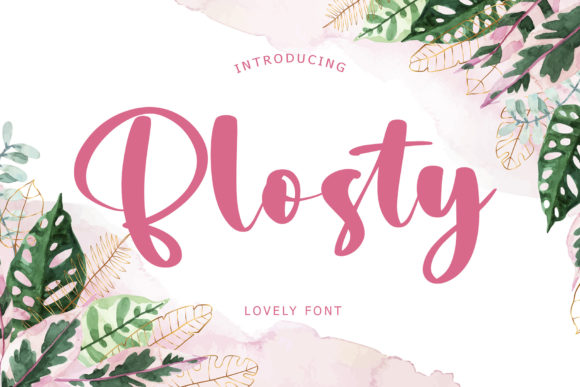
I started with the logo. Not the full lockup yet — just the studio’s name in Blosty, set large on a white artboard. Its distinct and well-rounded letters immediately softened the composition without sacrificing clarity. Unlike some overly flourished Script Handwritten fonts, Blosty has gentle terminals and open counters — meaning it stays legible even at smaller sizes (think business card corner or tagline beneath a monogram). I tested it alongside a warm, neutral serif for body copy — a pairing that gave the brand grounded elegance, not whimsy overload. As a Fonts choice for logos, Blosty works best as a primary display font: confident enough to anchor a mark, delicate enough to whisper craft and care.
Blosty for Product Labels and Minimalist Packaging Design
Next came the packaging — simple kraft boxes, matte sticker labels, and reusable cotton drawstring bags. I placed Blosty on a 12pt label reading “Stoneware • Hand-thrown • Oregon.” It held up beautifully. Because Blosty is a delicate and elegant handwritten font, its rhythm feels intentional, not hurried — perfect for products where process matters more than flash. No ligatures were needed; the natural spacing between characters kept text airy and breathable. For longer product descriptions, I switched to a clean sans serif, but every headline, ingredient list header, or seasonal tag (“Spring Collection”) stayed in Blosty. That consistency made the system feel curated, not chaotic.
Blosty for Social Media Graphics and Instagram Story Headers
When designing Instagram templates, I noticed how gracefully Blosty adapts to digital constraints. On mobile screens, its rounded forms retain charm without pixelating or collapsing. I used it for quote graphics (“Made slowly. Meant to last.”), event announcements (“Studio Open House — Sat, May 18”), and even subtle watermark-style accents behind photos of finished pieces. As a Script Handwritten font, Blosty adds humanity to feeds dominated by bold sans serifs — helping the studio stand out without shouting. Pro tip: avoid using Blosty for full paragraphs online. It shines brightest in short-form, high-impact moments — headlines, captions, callouts.
Blosty for Wedding Invitations and Elegant Branding
While this project wasn’t wedding-related, I couldn’t resist testing Blosty against classic invitation layouts — ivory paper, blind debossing, soft watercolor borders. It performed flawlessly. Its graceful curves echo traditional copperplate, but its modern openness keeps it from feeling dated. If you’re sourcing Fonts for luxury stationery, Blosty delivers timeless refinement without stiffness. Pair it with a fine hairline serif (think Playfair Display Light) for names and dates, then use a light sans for logistical details. The contrast feels intentional, elevated, and deeply personal — exactly what couples want when curating their most meaningful stationery.
Blosty for Website Headers and Editorial Design Projects
I dropped Blosty into the hero section of the studio’s homepage mockup — “Clay • Fire • Time” — and paused. It didn’t compete with the photography; it complemented it. That’s the power of a well-designed Script Handwritten font: it enhances tone without demanding attention. In editorial contexts — like a printed lookbook or newsletter — Blosty excels as a chapter opener or pull-quote font. Its versatility means it supports storytelling rather than interrupts it. Just remember: always test rendering across browsers. Blosty includes standard OpenType features (ligatures, stylistic alternates), so enabling them in CSS or Figma ensures optimal character flow.
Blosty for Business Cards, Shop Signs, and Printed Marketing Materials
Print is where Blosty truly sings. On letterpress business cards, its rounded terminals translated into soft, tactile impressions. On a small storefront window decal (“Open Daily • 10–6”), it read clearly from the sidewalk — no squinting required. Because Blosty is a delicate and elegant handwritten font, it avoids the harshness of digitized scripts, giving physical materials a handmade sincerity. For signage, I kept line length tight and leading generous — letting the font breathe. And yes, I checked licensing: Blosty includes commercial use rights, so it’s safe for client work, merchandise, and web embedding (with proper font hosting).
How to Test Blosty Before Committing to a Full Brand System
- Start with three real-use scenarios: a logo lockup, a product label, and an Instagram story frame.
- Type your client’s actual business name — not placeholder text — to assess rhythm and balance.
- Export samples at 72ppi (web) and 300ppi (print) to check sharpness and spacing fidelity.
- Pair it with one serif and one sans serif you already love — see which combo feels most authentic to the brand voice.
- Ask yourself: does this font make the brand feel more human? More intentional? More memorable?
If the answer is yes — and with Blosty, it almost always is — you’ve found more than just another Fonts download. You’ve found a quiet collaborator in your creative process: a Script Handwritten typeface that doesn’t shout, but lingers. A font that turns “handmade” from a descriptor into a feeling. Whether you're building a skincare line, launching a boutique, or designing for a local restaurant, Blosty helps you say less — and mean more.