Hello Baby Boy Script Handwritten Font for Sweet Creative Projects
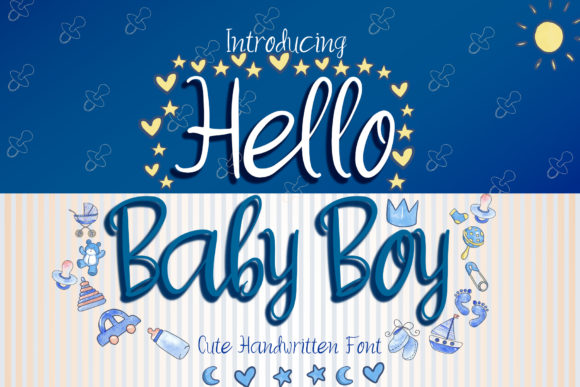
It started with a candle—just one lavender-vanilla soy candle in a matte white tumbler, waiting for its label. I opened my design file, scrolled past three other script fonts, and paused when Hello Baby Boy loaded. That first “Hello” looked like it had been written with a fine-tip marker on watercolor paper: soft edges, gentle bounce, just enough personality to feel handmade—not stiff, not overly ornate, but unmistakably warm. That’s the magic of this Script Handwritten font: it doesn’t shout. It leans in, smiles, and makes your product feel like something someone carefully made *for* someone.
Hello Baby Boy for Candle Labels and Handmade Product Packaging
I tested Hello Baby Boy on a 2-inch round candle label—“Lavender & Daydreams”—and it held up beautifully at small sizes. The rounded terminals and open counters kept each letter legible even when scaled down for jar sleeves or tea box tags. As a Script Handwritten font, it avoids the spiky thin strokes that often break on vinyl cutters, making it reliable for Cricut and Silhouette users. I paired it with a clean sans serif (like Montserrat Light) for ingredients and net weight—Hello Baby Boy handled the brand name and scent title while letting functional text stay crisp and scannable. For boutique packaging, that balance is everything: charm without clutter, sweetness without saccharine.
Hello Baby Boy for Wedding Invitations and Elegant Branding
When a friend asked me to design her wedding welcome board, I knew right away Hello Baby Boy would soften the formality of the date and venue without losing grace. Its gentle swash on the capital “H” and subtle baseline variation gave hand-lettered warmth—no tracing, no pressure to mimic calligraphy perfectly. As a Script Handwritten font, it works especially well for names (“Emma & James”), monograms, and short phrases like “Join Us” or “Love Grows Here.” I used it alongside a delicate serif (Cormorant Garamond) for body text—Hello Baby Boy stayed reserved for headings and accents, never overwhelming. For printable wedding stationery or digital invitation suites, this Fonts pairing adds quiet sophistication that feels intentional, not trendy.
Hello Baby Boy for Instagram Stories and Social Media Graphics
I’ve used Hello Baby Boy across dozens of Instagram story templates—birthday announcements, new listing alerts, seasonal shop updates—and every time, it stops the scroll. Why? Because unlike many playful scripts, it has consistent x-height and spacing, so text stays balanced even on mobile screens. As a Script Handwritten font, it reads clearly against textured backgrounds (linen overlays, soft gradients, muted photos), and its friendly rhythm invites engagement. I always export as PNG with transparent background, and Hello Baby Boy renders cleanly—no fuzzy edges or inconsistent kerning. For makers building a cohesive visual voice, this Fonts choice quietly strengthens recognition across posts, stories, and highlight covers.
Hello Baby Boy for Printable Wall Art and Planner Pages
My latest printable bundle—a set of minimalist nursery wall quotes—came together because of Hello Baby Boy. Phrases like “Little One, Big Love” and “Grow Wild & Gentle” needed softness, not stiffness. This Script Handwritten font delivered: each character has breathing room, and the lowercase “a” and “g” have charming alternate forms (included in the OTF file) that add subtle variety without distraction. On 8x10 prints, it’s delicate but present; on planner stickers, it holds detail even at 3/4 inch tall. Just remember—Hello Baby Boy shines in display use, not long paragraphs. Keep it for titles, affirmations, headers, and decorative accents. Pair it with a light-weight sans serif for dates, checkboxes, or notes.
Hello Baby Boy for Boutique Tags and Seasonal Craft Designs
Last December, I printed holiday gift tags using Hello Baby Boy on kraft cardstock—“For You,” “With Love,” “Merry & Bright.” The font’s slight irregularity made each tag feel individually inked, not mass-produced. As a Script Handwritten font, it’s versatile across seasons: swap “Merry” for “Happy Spring” or “Summer Days,” and the tone shifts effortlessly. For physical merchandise like mugs or tote bags, I tested laser-printed transfers and heat-pressed vinyl—Hello Baby Boy retained its integrity at medium sizes (1.5–2 inches tall), especially when I avoided over-tracking or extreme scaling. Always check the included file formats (.OTF/.TTF) and confirm commercial licensing covers your intended use—especially for SVG-based craft files or resale printables.
How Hello Baby Boy Works With Other Fonts in Real Design Files
In practice, Hello Baby Boy pairs best with contrast: a grounded sans serif (Poppins, Lato), a refined serif (Playfair Display), or even a second, bolder script for emphasis—but only if that second script shares similar proportions and energy. Avoid clashing weights or competing flourishes. Since Hello Baby Boy is a single-weight Script Handwritten font, it thrives when given space to breathe. Use it for primary messaging, then let supporting type handle hierarchy and function. And before finalizing any shop listing or printable preview, zoom in at 200%—check how the lowercase “e,” “s,” and “r” render on screen and in mockups. That’s where this Fonts style truly proves its handmade heart.